
9 Hair Care Fundamentals Every Cosmetology Student Must Master
If you are beginning your journey in beauty school, you are likely eager to learn the latest cutting and coloring techniques. But before you can create a perfect balayage or a flawless fade, you must first master the absolute hair care fundamentals. These basics are the foundation of your entire career, separating a hopeful amateur from a licensed, confident professional. Every successful service, from a simple shampoo to a complex chemical treatment, starts with understanding the science of the hair itself. This comprehensive guide details the nine core principles every cosmetology student needs to know to protect their client’s hair health and achieve stunning results.

Step 1: How to Professionally Analyze Hair
The first and most critical step in professional hair care is the client consultation and analysis. You cannot treat hair effectively without first understanding its unique characteristics. Proper hair analysis determines the hair’s current condition, its tolerance for chemical services, and the best product choices.
Understanding Hair Porosity: The Absorption Factor
Hair porosity describes the hair’s ability to absorb and retain moisture. It is determined by the condition of the hair cuticle, the outermost layer of the hair shaft. Knowing porosity is essential because it dictates how hair will react to coloring, deep conditioning, and styling.
- Low Porosity Hair: The cuticle layers are tightly bound and lay flat. This hair type resists water and chemical treatments, taking a long time to get wet and dry. Products often build up on the surface instead of absorbing.
- Medium Porosity Hair: This is the ideal, most balanced type. The cuticle is slightly looser, allowing moisture to enter and leave easily without being lost too quickly. This hair usually responds well and predictably to chemical services.
- High Porosity Hair: The cuticle is compromised, with gaps and openings (often due to genetics, chemical damage, or heat). This hair absorbs water quickly but loses it just as fast. It is prone to frizz, dryness, and needs protein treatments to temporarily fill the gaps.
Identifying Hair Texture vs. Hair Density
These terms are often confused, but they measure different things:
- Hair Texture: Refers to the thickness or diameter of the individual hair strand (fine, medium, or coarse). Fine hair is delicate, while coarse hair is strong but can be resistant.
- Hair Density: Refers to the number of hair strands growing per square inch of the scalp (low, medium, or high). A client can have fine hair (texture) but high density (many strands), requiring a completely different approach to cutting and styling than someone with coarse hair and low density.
What is Hair Elasticity and Why It Matters
Hair elasticity is the hair’s ability to stretch and return to its original length without breaking. It is a key indicator of internal health and strength.
- Good Elasticity: Healthy hair can stretch up to 50% when wet and snap back. This hair is strong enough to handle most chemical processes.
- Poor Elasticity: Hair snaps immediately when stretched. This indicates significant damage and protein loss. Chemical services (like coloring or perming) should be avoided until the hair’s integrity can be restored.
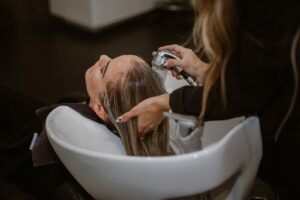
Photo by Lindsay Cash on Unsplash
Step 2: The Right Way to Cleanse and Condition
Washing hair seems simple, but professional-grade technique is all about precision and purpose. When you understand the science, you elevate the experience and the result.
How to Shampoo: Focus on the Scalp, Not the Ends
The primary function of shampoo is to cleanse the scalp, not the length of the hair. The scalp produces oil (sebum), sweat, and collects product residue, which needs a surfactant (shampoo) to be removed.
- Water Temperature: Use lukewarm water. Water that is too hot can strip the hair and scalp of natural oils, leading to dryness, and can cause hair color to fade faster by lifting the cuticle.
- Application: Apply shampoo directly to the scalp. Use the pads of your fingers (never your fingernails) to gently yet firmly massage the entire scalp in circular motions. This lifts debris and stimulates blood flow.
- Rinsing the Length: When you rinse, let the lather flow down the hair shaft. This cleansing action is sufficient for the mid-lengths and ends. Do not rub the shampoo into the hair’s length, as this can cause friction, tangles, and mechanical damage to the delicate cuticles.
The “Double Shampoo” Method Explained
For professional-level cleanliness, the double shampoo method is highly recommended, especially when working on a client with heavy product buildup or an oily scalp:
- First Wash: Use a small amount of product. This wash primarily focuses on breaking down oils and surface buildup. You may notice less lather during this step. Rinse thoroughly.
- Second Wash: Use an even smaller amount of product. Because the heavy buildup is gone, the shampoo can now penetrate and cleanse the scalp thoroughly, resulting in a richer, fuller lather. This ensures the scalp is squeaky clean, which helps hair stay fresh longer.
How to Condition: Mid-Lengths and Ends Only
Conditioner is designed to re-moisturize the hair, replenish lipids, and smooth the outer cuticle layer that the shampoo process may have slightly raised.
- Remove Excess Water: Gently squeeze water out of the hair before applying conditioner. If the hair is soaking wet, the conditioner will be too diluted and cannot penetrate the hair shaft effectively.
- Target the Ends: Apply conditioner from the mid-shaft down to the ends. The ends are the oldest, driest, and most damaged part of the hair. Avoid applying conditioner directly to the scalp, as this can weigh down the roots and cause the hair to appear greasy quickly.
- Detangle Gently: Use a wide-tooth comb to distribute the conditioner evenly and detangle the hair while the conditioner is still in. This is when hair is most slippery and easiest to detangle with minimal breakage.
- Rinse with Cooler Water: A final rinse with cooler water can help seal the cuticle, locking in moisture and maximizing shine.
Photo by Rapha Wilde on Unsplash
Step 3: Protecting Hair from Common Damage
One of your most important roles as a stylist is educating your clients on damage prevention. Here are the three main types of damage and how to combat them using the core hair care fundamentals.
Heat vs. Chemical Damage: What’s the Difference?
- Chemical Damage: This is damage to the internal structure (cortex) of the hair, caused by services like bleaching, permanent coloring, relaxing, or perming. These processes intentionally break chemical bonds in the hair to achieve a permanent change, making the hair weaker and more porous.
- Heat Damage: This is damage to the outer layer (cuticle) and protein structure, caused by excessive or direct heat from tools like flat irons, curling irons, and blow dryers. Heat can literally change the hair’s keratin structure, leading to dryness and breakage.
Prevention Tips:
- The Heat Shield: Always use a heat protectant product before any hot tool use. These products create a thermal barrier that slows heat transfer to the hair.
- Limit Heat Exposure: Advise clients to use the lowest effective heat setting and to allow hair to air dry most of the way before using a blow dryer.
Avoiding Mechanical Damage (Towel Rubbing, Brushing Wet Hair)
Mechanical damage is physical stress on the hair. This type of damage is often caused by common, simple mistakes:
| The Habit to AVOID | The Professional Solution |
| Vigorous Towel Rubbing | Blot or wrap hair in a microfiber towel or an old cotton T-shirt. This absorbs moisture gently without creating frizz or cuticle damage. |
| Brushing Wet Hair | Hair is most fragile when wet. Use a wide-tooth comb or a detangling brush specifically designed for wet hair. Always start detangling at the ends and work your way up. |
The Truth About Tight Hairstyles and Breakage
Hair pulled back tightly into ponytails, buns, or braids creates a constant, low-level tension on the hair follicle. Over time, this constant tugging can lead to a condition called traction alopecia, causing hair thinning and loss around the hairline.
- Recommendation: Advise clients to alternate tight styles with loose ones. Always use covered elastic bands or scrunchies instead of bare rubber bands, which can cause significant breakage and friction.

Photo by Nathan Dumlao on Unsplash
Step 4: How Nutrition Affects Hair Health
Hair health starts beneath the surface. As a cosmetology professional, you should understand the connection between internal health and external hair condition, as this allows you to give more holistic client advice.
The Role of Protein and Key Nutrients
Hair is primarily made of a protein called keratin. Therefore, a diet rich in high-quality protein is non-negotiable for growing strong, healthy hair.
- Protein Sources: Lean meats, fish, eggs, lentils, and beans provide the necessary amino acids (building blocks) for keratin production.
- Key Micronutrients: Deficiencies in essential nutrients like Iron (needed for oxygen delivery to follicles) and Zinc (important for hair tissue growth and repair) are scientifically linked to hair thinning and loss.
- Healthy Fats: Omega-3 fatty acids, found in fatty fish, avocados, and nuts, are vital for scalp health and contribute to hair’s natural shine.
Why Crash Diets Can Lead to Hair Shedding
Hair is incredibly sensitive to sudden changes in the body. When a client undergoes rapid weight loss or engages in a severe calorie- or protein-restricted “crash diet,” the body views hair growth as non-essential. This stress can shock the hair follicles, pushing them into a resting phase prematurely. This results in telogen effluvium, which is a noticeable increase in hair shedding, usually occurring two to three months after the stressful event.
A key hair care fundamentals lesson is that balance is key. Even for supplements, excessive intake of certain vitamins like Vitamin A or the mineral Selenium can actually cause hair loss. Always suggest a consultation with a healthcare professional before clients begin high-dose supplementation.
Mastering the Basics for a Successful Future
Mastering these hair care fundamentals is the essential first step on your path to becoming a top stylist. Your deep understanding of hair analysis, professional washing techniques, and damage prevention is what will ultimately set you apart in a competitive industry. When you walk into the salon with this knowledge, you are not just a stylist—you are a hair health expert, ready to advise your clients and build a thriving career based on trust and incredible results.
Ready to turn your passion for beauty into a professional license?